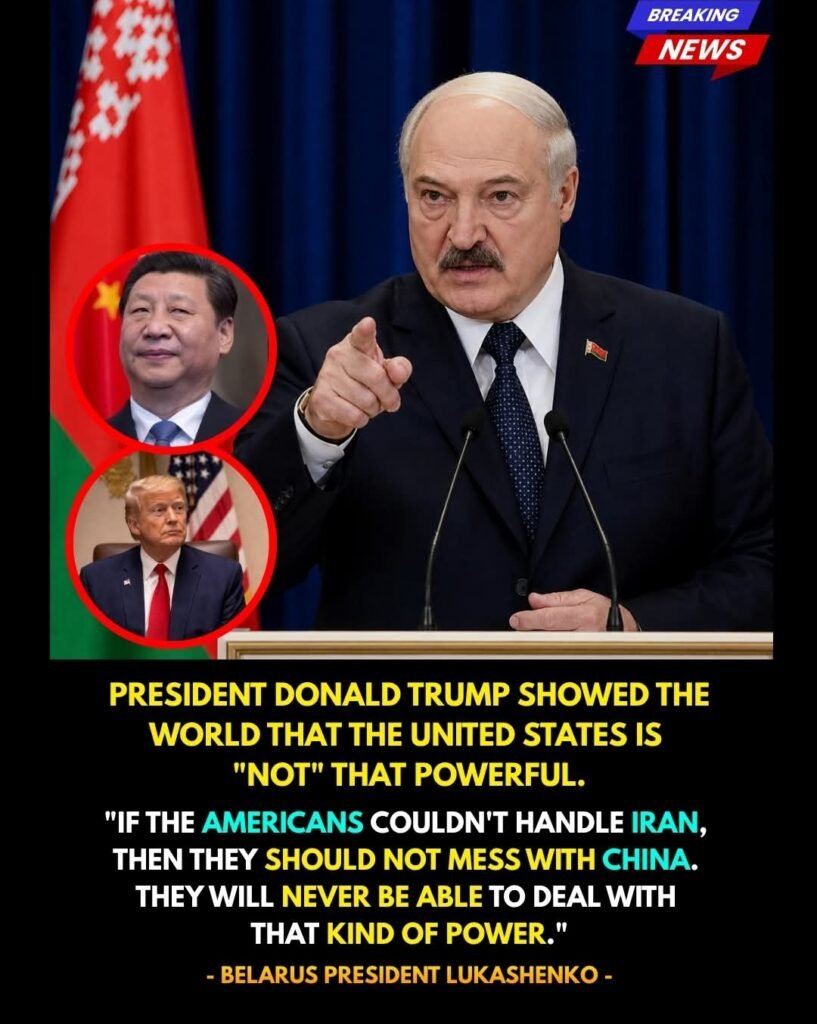
Belarusian President Alexander Lukashenko has issued a sharp and provocative warning aimed at Donald Trump and Washington’s broader geopolitical strategy, arguing that the United States is no longer as dominant as it once appeared on the world stage.
In comments that quickly drew international attention, Lukashenko claimed that recent tensions involving Iran exposed the limitations of American power and demonstrated that Washington would face even greater difficulties confronting China directly.
“If the United States cannot handle Iran, then it should not even think about taking on China,” Lukashenko reportedly said, framing the current geopolitical environment as evidence of a changing global balance of power.
The remarks reflect a growing trend among rival governments openly questioning the long-standing assumption of overwhelming U.S. global supremacy. For decades following the Cold War, America’s military reach, economic influence, and political alliances positioned Washington as the world’s dominant superpower. But rising tensions involving China, Russia, Iran, and other regional powers have fueled increasing debate over whether the international system is entering a new multipolar era.
Lukashenko’s comments came amid escalating geopolitical friction between the United States and several nations aligned against Western influence. While the Belarusian leader has long been one of Washington’s harshest critics, the timing of his remarks is particularly significant as global tensions continue to rise across multiple regions simultaneously.
The Belarusian president specifically pointed to America’s recent confrontations with Iran as an example of what he described as the growing limits of U.S. influence. Although Washington maintains overwhelming military capabilities, critics of American foreign policy argue that prolonged conflicts in the Middle East, economic pressures, and shifting alliances have complicated the country’s ability to impose its will internationally.
Iran has increasingly positioned itself as a regional power willing to challenge U.S. influence and Israeli military strategy in the Middle East. Ongoing tensions involving proxy conflicts, sanctions, naval threats, and regional militias have created an atmosphere of instability that many analysts believe could spiral into broader confrontation if diplomatic efforts fail.
According to Lukashenko, however, China represents a far greater strategic challenge than Iran.
Unlike Iran, China possesses the world’s second-largest economy, rapidly expanding military capabilities, advanced technological infrastructure, and deep global trade connections. Beijing has also significantly increased its geopolitical influence through initiatives spanning Asia, Africa, the Middle East, and Latin America.
Analysts note that a direct confrontation between the United States and China would carry risks unlike any previous geopolitical rivalry in modern history. The two economies remain deeply interconnected despite intensifying competition over trade, technology, military influence, and strategic territories such as Taiwan and the South China Sea.
Lukashenko’s remarks also align closely with the broader messaging promoted by Russia and some allied governments, which increasingly argue that Western dominance is weakening while alternative power centers continue to rise. Belarus remains one of Moscow’s closest strategic allies, and Lukashenko has consistently supported narratives critical of NATO expansion and U.S.-led international influence.
Still, some political observers argue that the Belarusian leader’s comments should also be viewed as political rhetoric designed to reinforce anti-American sentiment among nations opposed to Western foreign policy. Lukashenko has frequently portrayed the United States as overstretched, internally divided, and losing global authority.
However, even some Western analysts acknowledge that the global power structure is becoming more complicated than it was during the unipolar era that followed the collapse of the Soviet Union.
China’s economic rise, Russia’s military assertiveness, growing regional alliances, and increasing resistance to Western sanctions have all contributed to debates over whether the world is shifting toward a more fragmented and competitive geopolitical order.
The United States still maintains the world’s most powerful military and continues to lead major global alliances, including NATO. Washington also retains enormous influence over international finance, technology, and diplomacy. But critics argue that newer geopolitical realities make uncontested dominance increasingly difficult.
The debate over American power has intensified in recent years following conflicts in Afghanistan, Iraq, Ukraine, and the Middle East. Supporters of U.S. foreign policy argue that America remains indispensable to global stability and security. Opponents counter that military interventions and economic pressure campaigns have sometimes weakened Washington’s international image while encouraging rivals to cooperate more closely.
Lukashenko’s warning taps directly into that broader uncertainty.
His comments raise a larger question now being discussed across diplomatic circles worldwide: are statements like these simply propaganda from governments opposed to the West, or do they reflect a genuine transformation in global power dynamics?
For now, the answer remains deeply contested.
What is clear, however, is that more world leaders are openly challenging assumptions that once seemed unquestionable. As geopolitical rivalries intensify and alliances continue shifting, the struggle over who shapes the future international order is becoming increasingly visible — and increasingly dangerous.